


"Seeing the Whole School" Through Proximity and Purpose

Updated: Jul 31
Most people experience a school through one lens.
Students experience the classroom, the hallway, the residence hall, the advising conversation, the rehearsal, the laboratory, the cafeteria table, the late-night worry, the moment of confidence, or the moment when things begin to fall apart. Families experience communication, opportunity, safety, trust, cost, and the hope that the school will see their child clearly. Teachers and staff experience the school through the responsibilities closest to them: a course, a caseload, a program, a policy, a budget, a facility, a recruitment season, or a conversation no one else sees.
Communities experience schools differently still. They see reputation, outcomes, access, public value, partnership, pride, frustration, promise, and accountability. Board members, donors, policymakers, alumni, and civic leaders often see the school through questions of trust, sustainability, stewardship, and long-term contribution. Each of these views is real. None of them is the whole school.
That has been the underlying thread of this series: schools are harder to understand than they first appear because the work is so widely distributed. A school is not simply what happens in classrooms, though instruction is central. It is not simply what happens in counseling offices or residence halls, though student support is essential. It is not simply what happens in operations, admissions, communications, governance, or public accountability, though each of those areas shapes what the school can actually be.
A school is a living institution. It is shaped by students, programs, systems, families, communities, histories, aspirations, obligations, and trust. It is intensely personal and deeply institutional at the same time. It must care for individual students while also stewarding a mission larger than any one student, family, staff member, program, or moment.
We often try to understand schools through structure alone. We draw organizational charts. We write job descriptions. We establish reporting lines. We publish strategic plans. We create handbooks, dashboards, policies, procedures, and committee structures. These tools matter because schools need structure to function and clarity to endure. But structure is not the same as understanding.
An organizational chart can tell us who reports to whom, but it does not tell us what each person sees most clearly from where they stand. A job description can list responsibilities, but it rarely explains the larger purpose those responsibilities are meant to serve. A strategic plan can describe where the school is trying to go, but it does not always show how the daily work of the institution is experienced differently by the people closest to students, closest to programs, closest to internal systems, or closest to the families and stakeholders whose trust makes the school possible.
That is where schools often struggle. Not because people are careless. Not because they lack commitment. Not because one group cares about students and another only cares about the institution. More often, people are seeing the school from different places and mistaking their vantage point for the whole.
The purpose of this series has been to ask us to see beyond our own doorway. In the earlier episodes, that meant looking inward and outward, noticing the work of others, and recognizing that healthy schools require more than goodwill or individual effort. In this final reflection, I want to give that idea more structure by returning to the model underneath the series: the Proximity and Purpose Continuum for Schools.
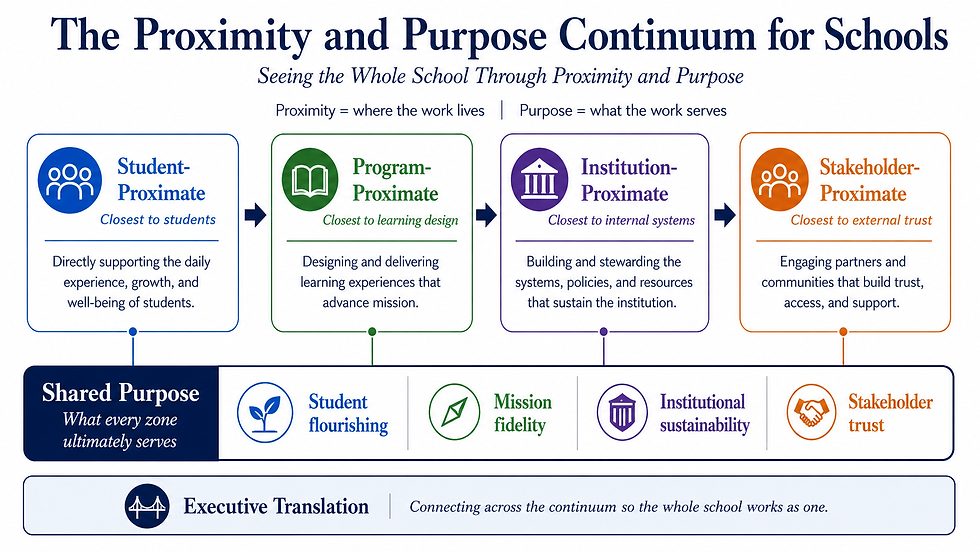
The continuum begins with a simple distinction: Proximity describes where the work lives. Purpose describes what the work must serve.
Proximity is about nearness. It asks where a role’s daily attention, relationships, energy, and problem-solving are most directly located. Some people in a school are closest to individual students and their daily experience. Some are closest to the programs and learning structures through which the school delivers on its mission. Some are closest to the internal systems that keep the institution responsible, sustainable, safe, staffed, and functional. Others are closest to the external stakeholders whose trust, support, scrutiny, advocacy, and expectations shape the school’s legitimacy and reach.
Purpose is about meaning and responsibility. It asks what larger mission should guide the work, even when the daily task feels narrow. In schools, purpose includes student flourishing, but it also includes mission fidelity, institutional sustainability, and stakeholder trust. A school exists for students, but it can only serve students well if the institution remains coherent, credible, responsible, and worthy of confidence over time.
This distinction is important because the continuum is an adult-facing framework, but it is not an adult-centered one. Students are not one zone on the continuum. They are the reason the continuum exists. Student-proximate roles are closest to students in daily experience, but every role in a school must remain accountable to student flourishing. Programs serve students by translating mission into learning. Institutional systems serve students by making the school sustainable, safe, and credible. Stakeholder-facing work serves students by building trust, access, legitimacy, and support around the school’s mission. The continuum maps the adult work of the school, but students remain the bedrock of its purpose.
The first zone is Student-Proximate work. This is the work closest to individual students and their daily experience of the school. It includes teaching, advising, counseling, mentoring, residential life, academic support, wellness, conduct, belonging, and student development. These are the roles that often see student needs first and most vividly. They know how a policy lands on a tired student, how a schedule feels when a student is overextended, and when a student is thriving, hiding, struggling, acting out, or quietly slipping through the cracks.
Student-Proximate work keeps schools humane. It reminds the institution that students are not abstractions. They are not simply enrollment numbers, test scores, disciplinary cases, college placements, scholarship recipients, or alumni outcomes in progress. They are developing people with talent, anxiety, pride, immaturity, resilience, vulnerability, aspiration, family context, and uneven readiness for the demands placed before them.
But proximity to students cannot mean responding only to the immediate preference or pain of the student in front of us. Care is not the same as removing every challenge. Support is not the same as lowering every expectation. Advocacy is not the same as ignoring standards, community obligations, or long-term development. A school can care deeply for students while still expecting them to meet obligations, repair harm, persist through difficulty, and grow into the responsibilities of a shared community.
That is part of the tension of Student-Proximate work. It exists between care and formation. It requires attentiveness to the individual student, but not in a way that forgets the broader environment the student is part of. The student-proximate adult often carries a deeply personal kind of knowledge about the school. They see the human consequences of institutional decisions. That view is essential, but it is still one vantage point.
The second zone is Program-Proximate work. This is the work closest to the design, delivery, and improvement of the educational experience. It includes curriculum, academic programs, enrichment, assessment, co-curricular structures, advising systems, student support models, learning pathways, faculty development, instructional innovation, and program evaluation. Program-Proximate work asks whether the school’s mission is actually built into its design.
Schools do not fulfill their mission through intention alone. They fulfill it through structures. What we require, what we offer, how we sequence learning, how we support students, how we define excellence, and how we improve over time all communicate what the school believes. Programs are not just things schools have. They are how schools make their promises real.
This work can be easy to overlook because programs often become familiar. Once a schedule exists, once a course sequence is established, once a student support structure becomes routine, people can begin to treat it as natural. But every program is a set of choices. Some choices are intentional. Some are inherited. Some are aligned with mission. Some remain because no one has slowed down long enough to ask whether they still serve the students in front of us.
Program-Proximate work helps the school ask harder questions about coherence. Are students being challenged in the right ways? Are they supported at the right moments? Are the structures of learning aligned with the students the institution actually serves, not just the students it imagines? Are programs rigorous without becoming inaccessible? Are they innovative without becoming fragmented? Are they sustainable for the faculty and staff who carry them?
When Program-Proximate work is healthy, it connects student need to institutional design. It turns mission into architecture. When it becomes narrowed, however, it can protect the program more than the promise the program exists to fulfill. A program can be elegant on paper and still fail students in practice. It can be rigorous without being developmental, creative without being coherent, or mission-aligned in language but misaligned in daily experience.
The third zone is Institution-Proximate work. This is the work closest to the internal systems that sustain the school. It includes operations, finance, facilities, human resources, compliance, governance, accreditation, risk management, staffing, policy, data systems, and organizational sustainability. These roles may sometimes feel farther away from the daily student experience, but they are not separate from the educational mission. They create the conditions under which the mission can endure.
A school without sound finances cannot serve students well for long. A school without responsible staffing cannot deliver on its promises. A school without safe facilities, reliable systems, thoughtful policies, and appropriate compliance structures cannot protect its community. A school without governance and institutional discipline cannot maintain trust. These functions may not always look like care in the immediate, relational sense, but at their best they are acts of stewardship.
Institution-Proximate work protects the school’s ability to serve not just today, but over time. It asks whether the school can sustain its commitments, whether it can staff the work responsibly, whether it can maintain standards fairly, whether it can manage risk wisely, and whether it can support mission with actual resources rather than aspiration alone.
This work can become distorted. Systems can become self-protective. Policies can become rigid. Risk management can become risk avoidance. Financial sustainability can become scarcity thinking. Compliance can become an excuse for moral distance. When Institution-Proximate roles lose sight of purpose, the school may remain orderly while becoming less humane.
But the opposite danger is just as real. When Student-Proximate or Program-Proximate work loses sight of institutional reality, schools can be asked to make promises they cannot keep. They can underweight fairness, precedent, staffing capacity, legal responsibility, resources, or long-term sustainability. They can begin to treat institutional concerns as obstacles to mission rather than conditions that make mission possible.
This is why care and stewardship belong together. Care without stewardship becomes fragile. Stewardship without care becomes hollow.
The fourth zone is Stakeholder-Proximate work. This is the work closest to the external constituencies, relationships, and accountability structures that shape the school’s reach, legitimacy, support, and public trust. It includes admissions, recruitment, family engagement, communications, advancement, alumni relations, partnerships, government relations, community relations, donors, policymakers, media, prospective families, accrediting bodies, and the broader public.
This kind of work is sometimes dismissed as peripheral to the real work of education. But schools do not exist in isolation. Others have a vested interest in the institution and its mission. Families trust schools with their children. Public institutions are accountable to taxpayers, legislators, agencies, and communities. Private institutions answer to families, trustees, donors, alumni, accrediting bodies, and the broader marketplace of trust. Partner schools, civic leaders, employers, and communities often depend on the school’s credibility and contribution.
Stakeholder-Proximate work makes the institution’s mission visible, understandable, accessible, fundable, and trusted. Admissions is not merely recruitment. Communications is not merely branding. Advancement is not merely fundraising. Government relations is not merely politics. Partnerships are not merely visibility. These functions help connect the school to the world around it, and they often shape whether the school has the trust and resources required to do its work well.
But this zone has its own risk of tunnel vision. A school can become too focused on how it is perceived. It can mistake reputation for reality, growth for success, visibility for impact, or stakeholder approval for mission fidelity. It can tell a story externally that is more polished than true. It can chase enrollment, funding, political support, or public attention in ways that drift from student fit and educational integrity.
The answer is not to devalue stakeholder trust. Trust matters. Legitimacy matters. Public accountability matters. The answer is to connect Stakeholder-Proximate work to purpose. The external story of the school must be grounded in internal reality. The promises the school makes must match its capacity. Its reputation must be earned through the lived experience of students and the integrity of the institution.
Those are the four zones of the continuum: Student-Proximate, Program-Proximate, Institution-Proximate, and Stakeholder-Proximate. They are not fixed boxes. People do not permanently live in one domain and never touch the others. A teacher may be student-proximate when helping a student through a difficult moment and program-proximate when redesigning a course. An admissions professional may be stakeholder-proximate during recruitment season and student-proximate when thinking carefully about fit, readiness, and support. A superintendent, principal, head of school, or executive director may move across all four zones in the course of a single morning.
That is why continuum language matters. This is not a set of silos. It is a spectrum of adult work connected by shared purpose.
In the visual model, the four proximity zones sit above a band labeled Shared Purpose. That is what every zone ultimately serves: student flourishing, mission fidelity, institutional sustainability, and stakeholder trust.
Student flourishing is the most obvious purpose, and rightly so. Schools exist so that students can learn, grow, belong, develop, discover capacity, build confidence, and move toward lives of meaning and contribution. If a school loses sight of student flourishing, it has lost the reason for its existence.
Mission fidelity asks whether the school remains true to its core commitments. It pushes against drift, convenience, politics, habit, and the temptation to become whatever the moment rewards. Institutional sustainability reminds us that good intentions are not enough. A school must have the resources, staffing, systems, standards, facilities, and discipline to serve well over time. Stakeholder trust recognizes that schools are accountable communities whose credibility with families, boards, policymakers, donors, alumni, partners, and the broader public helps create the conditions in which the school can operate, grow, and endure.
The purpose layer matters because proximity alone can narrow us. It is natural to care most about the part of the school we touch most directly. The continuum does not scold us for that. It simply reminds us that our vantage point is not the whole. The Student-Proximate role may see the student but miss the system. The Program-Proximate role may see the design but miss the individual experience. The Institution-Proximate role may see sustainability but miss the human cost. The Stakeholder-Proximate role may see trust and legitimacy but miss internal complexity.
Every vantage point is valuable. Every vantage point is incomplete. That is where the work of mutual respect begins. Not with vague appreciation, but with a more disciplined understanding of how distributed the work of a school really is. Respect in a school does not come only from saying that everyone’s work matters. It comes from understanding how each kind of work contributes to the whole.
Consider a state-level initiative designed to expand access to advanced learning, career pathways, early college opportunities, STEM programming, arts education, or some other priority that policymakers, state education leaders, and community stakeholders believe will benefit students. The goal may be admirable. The need may be real. The policy may bring visibility, expectations, possible funding, and public attention. But the initiative does not implement itself.
At the Stakeholder-Proximate level, the initiative begins with public purpose. State leaders are looking at access, outcomes, workforce needs, equity, regional opportunity, family demand, or civic value. They may see the school as a partner in meeting a broader public need and ask how more students can benefit, how successful models can reach more communities, or how the school’s expertise can serve beyond its existing walls.
Those are important questions. But they are not the whole implementation reality.
At the Institution-Proximate level, the school has to ask what the initiative requires internally. Who will staff it? How will it be funded after the first announcement? What compliance requirements come with it? What data must be tracked? What policies need to change? What technology, facilities, schedules, supervision, or administrative systems are required? What existing commitments might be stretched by the new work?
This is where public aspiration meets institutional capacity. A good idea can still fail if it is not resourced, staffed, governed, and sustained responsibly.
At the Program-Proximate level, the initiative has to become an actual educational experience. What will students learn? Who will teach them? What supports will be available? How will quality be defined? What does success look like? How does the new initiative connect to existing curriculum, advising, assessment, and student development structures? Is the program coherent, or is it simply a new label placed on disconnected activities?
This is where the initiative becomes more than a press release or policy priority. It becomes design, sequence, support, expectations, assessment, and improvement.
At the Student-Proximate level, the question becomes even more direct. How will students actually experience this opportunity? Will it meet a real need? Will they understand what they are entering? Will they be supported if the work is challenging? Will the initiative expand genuine opportunity, or will it create a pathway that sounds good externally but feels confusing, thin, or overwhelming internally?
Each zone sees something essential. Stakeholder-Proximate work sees public need and trust. Institution-Proximate work sees capacity and sustainability. Program-Proximate work sees design and quality. Student-Proximate work sees lived experience and development. None of those views should be dismissed. None should be allowed to dominate by itself.
If the stakeholder view dominates, the school may overpromise in response to public enthusiasm. If the institutional view dominates, the school may become so cautious that it misses an opportunity to serve. If the program view dominates, the school may design something elegant but too slow or complex to meet the moment. If the student-proximate view dominates alone, the school may focus on immediate support without attending enough to scale, policy, resources, or accountability.
The better question is not whether the initiative is good or bad in the abstract. The better question is how the school can translate a public priority into a student-serving, mission-aligned, educationally credible, operationally sustainable, and trustworthy program.
That question is the continuum in practice. It also leads to the final part of the model: Executive Translation.
Executive Translation is not about top-down control. In the visual model, it is not the command center above the continuum. It is the connective work that runs alongside and across the continuum. It is the leadership practice of helping the different zones understand one another.
Formal leaders carry a special responsibility for this, whether they are principals, heads of school, superintendents, executive directors, division leaders, or senior administrators. They are often the ones who must translate public expectations into institutional plans, institutional constraints into program design, program needs into budget requests, student realities into policy conversations, and stakeholder trust back into mission fidelity.
But Executive Translation is not only about the executive. It is about the function of translation that healthy schools need. The formal leader may carry the broadest responsibility for it, but everyone benefits when the school develops a shared language for how the parts connect.
Executive Translation helps Student-Proximate roles understand that institutional constraints are not always indifference. It helps Institution-Proximate roles remember that systems exist to serve people. It helps Program-Proximate roles connect design to lived student experience and long-term capacity. It helps Stakeholder-Proximate roles tell the school’s story truthfully, without smoothing away complexity or exaggerating capacity. It helps everyone resist the temptation to reduce school decisions to simple binaries.
Support or standards. Care or accountability. Innovation or sustainability. Growth or fit. Public trust or internal reality. The most important school decisions rarely belong only to one side of those pairings. They live in the space between them. That space is not a failure of clarity. It is where the real work of schools happens.
That is why seeing the whole school is not just an act of empathy. It is an act of discipline. It asks us to honor the work closest to us without dismissing the work farther away. It asks us to recognize that what feels distant from students may still be deeply student-serving. It asks us to understand that what feels compassionate in the moment still has to be connected to mission, standards, and sustainability. It asks us to build respect not only through kindness, but through clearer understanding.
A school does not succeed because everyone stands in the same place. It succeeds when people understand where their work is closest, what their work ultimately serves, and how their part of the continuum connects to the whole.
The Student-Proximate work matters. The Program-Proximate work matters. The Institution-Proximate work matters. The Stakeholder-Proximate work matters. Not in the same way, not on the same day, not always with the same urgency, and not always with the same visibility. But all of it is necessary.
And that is the call of the full series. We need to see our own work clearly, but not exclusively. We need to recognize the work of others, but not sentimentally. We need to understand that schools are held together by people whose responsibilities may look different, feel different, and operate at different distances from students, but who are still part of the same shared purpose.
Students are the reason the continuum exists. But students are served best when the full spectrum of adult work is connected, coherent, and honest about what it takes to help a school fulfill its mission over time. The work is broader than any one role. The school is larger than any one vantage point. The purpose is too important to be carried by one part of the institution alone.
To see the whole school, we have to understand both proximity and purpose. We have to know where the work lives. We have to know what the work serves. And then we have to do the harder, more generous, more disciplined work of connecting our part to the whole.


Comments